

Every major HGV make runs engines that depend on the cooling system holding a stable operating temperature. Get that wrong and the consequences go beyond a breakdown: a warped head, a blown gasket, a damaged turbo, or in serious cases, a block that's done.
This guide covers everything from a driver's daily walk-round to a workshop full service. So if you need guidance on your HGV cooling system maintenance, you’re in the right place.
What each part of the cooling system does
Water pump
The water pump circulates coolant continuously around the engine block, through the radiator, and back again. On most heavy-duty diesels it is belt-driven off the crankshaft pulley and runs from engine start to shutdown. When the pump fails, coolant flow drops or stops, and engine temperature climbs quickly because nothing is moving heat away from the block.
Signs of a pump starting to fail may include coolant weeping from the pump body's weep hole (a deliberately engineered warning), bearing noise under load, or a coolant temperature that is trending up gradually without any other obvious cause.
Browse water pumps.
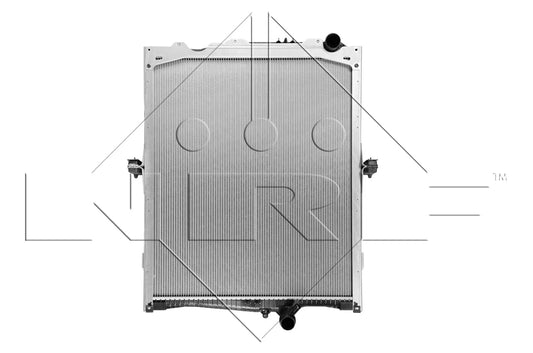
Radiator
The radiator is where heat leaves the system. Hot coolant passes through a network of tubes and fins; air moving through those fins carries the heat away. A radiator can be structurally sound and still underperform badly if the fin faces are blocked with road film, insects, or debris, because that restricts the airflow the whole system depends on.
Internal scale and sludge cause slow deterioration rather than sudden failure, which makes them harder to catch. A radiator that is clean externally but scaled internally will run coolant hotter than the design temperature and raise the thermal load across the whole engine.
Browse radiators.
Thermostat
The thermostat is a temperature-controlled valve. It stays closed while the engine warms up, so coolant circulates through the engine block only and reaches operating temperature faster. Once the engine is up to temperature, the thermostat opens progressively to allow coolant flow to the radiator.
A thermostat stuck closed causes rapid overheating. A thermostat stuck open is subtler: the engine runs slightly cool, fuel consumption increases, and some engines will log a fault code for temperature out of range even though nothing feels wrong to the driver.
Browse thermostats.
Pressure cap
The pressure cap seals the cooling system and allows it to run above atmospheric pressure, which raises the coolant's effective boiling point well above 100°C. It also acts as a safety valve, releasing excess pressure into the expansion tank if it climbs too high.
The pressure rating is stamped on the cap itself. Fitting the wrong rated cap either means the system will not hold pressure correctly or will release it at the wrong point, both of which affect how the coolant behaves under load.
Browse expansion tanks and the full cooling parts range.
Hoses and belts
Cooling hoses carry fluid between the engine, radiator, and expansion tank. They degrade from the inside as much as the outside. Squeeze hoses along their length during routine checks. A hose that is soft or mushy where it should be firm needs replacing regardless of its external appearance.
Belts drive the water pump and on many trucks the cooling fan. A glazed, cracked, or under-tensioned belt can slip under load, which reduces pump speed and fan speed precisely when the engine is working hardest and needs both most.
Browse belt tensioners.
Cooling fan and fan clutch
The cooling fan draws air through the radiator when road speed does not provide enough natural airflow. On most heavy-duty trucks it is driven through a viscous fan clutch, which uses a temperature-sensitive bimetal strip to engage or disengage the fan based on radiator outlet temperature. At low temperatures the fan freewheels, but at high temperatures it locks up and pulls full air through the radiator core.
A fan clutch that is slipping will not engage properly when the engine needs it, typically at low road speed, during extended idle, or in heavy traffic in summer. The engine will run hotter than normal but may not immediately trigger the temperature warning. A clutch seized in the locked position runs the fan at full speed permanently, which costs fuel and creates excessive noise but will not cause overheating.
Check clutch engagement by feeling for resistance when the engine is at operating temperature with the vehicle stationary: a fan that spins freely at idle on a warm engine is a suspect clutch.
Browse cooling fans and fan clutches.
EGR cooler
The EGR (Exhaust Gas Recirculation) cooler is a heat exchanger fitted as part of the emissions control system on Euro 5 and Euro 6 engines. Its job is to cool exhaust gases before they are recirculated into the engine intake, which reduces combustion temperatures and NOx emissions. The EGR cooler runs off the main cooling circuit, so its failure directly affects both coolant condition and volume.
When an EGR cooler fails internally, exhaust gas enters the coolant. The most reliable indicator is coolant that is becoming acidic faster than degradation alone would account for, confirmed by pH testing.
External failure usually shows as unexplained coolant loss without a visible external leak, or coolant reaching the intake manifold, which produces white smoke and a sweet exhaust smell that resembles a head gasket failure but originates at a different point in the system.
On high-mileage Scania, MAN, and Mercedes-Benz Euro 5 engines in particular, EGR cooler failure is common enough that it should be on the diagnostic list early when unexplained coolant loss or rapid acidification appears. Diagnosis requires a pressure test and in many cases a boroscope inspection: this is not a driver-level check.
Browse EGR coolers.
Oil cooler
The oil cooler is a plate or tube heat exchanger that regulates engine oil temperature using coolant from the main circuit. It sits between the oil filter and the engine block on most heavy-duty diesels and keeps oil within its operating temperature range, which affects lubrication film strength and oil service life.
When an oil cooler fails internally, the result is either oil contaminating the coolant or coolant contaminating the oil. Oil in coolant appears as a brown, greasy film on the expansion tank cap or a slick on the coolant surface in the reservoir. Coolant in oil produces the milky, emulsified appearance on the dipstick or filler cap that most workshops associate with a head gasket failure, but the source is different and the diagnostic steps are different.
An oil cooler failure usually will not affect coolant temperature as dramatically as a head gasket failure. Pressure testing the system alongside checking oil condition and oil pressure will usually separate the two causes before any component is removed.
Browse oil coolers.
Charge air cooler
The charge air cooler reduces the temperature of compressed air leaving the turbocharger before it enters the engine intake. Cooler air is denser, which improves combustion efficiency and protects the engine from heat stress. On most HGVs the charge air cooler is air-to-air, using ambient airflow rather than coolant; on some engines it is water-to-air, using the main cooling circuit.
Either way, the charge air cooler sits at the front of the vehicle alongside the main radiator and is exposed to the same road debris, insects, and film that blocks radiator fins. A partially blocked charge air cooler reduces charge air density, increases exhaust temperatures, and puts additional load on the turbocharger. Check and clean it at the same time as the radiator core, not as a separate task.
Browse charge air coolers.
Coolant and antifreeze: what is in the system?
"Antifreeze" and "coolant" get used interchangeably, but they are not the same thing.
Antifreeze is the concentrated glycol-based fluid that needs diluting before use. Coolant is the ready-mixed result, typically a 50/50 ratio of antifreeze and demineralised water, though the correct ratio for a given application should be confirmed against the manufacturer's data sheet rather than assumed.
There are three coolant chemistries in widespread use across HGV fleets, and mixing them incorrectly is where most avoidable damage happens.
-
Inorganic Acid Technology (IAT) uses silicates and phosphates for corrosion protection. It requires more frequent changes and, on many heavy-duty diesel engines, regular top-ups of Supplemental Coolant Additives (SCAs) to maintain cylinder liner protection. IAT coolant remains present in older fleet vehicles and some engine types where the manufacturer specifies it.
-
Organic Acid Technology (OAT) is the extended-life chemistry used as standard on most modern heavy-duty diesel engines. It does not rely on silicates, holds its additive package longer, and is the basis for most long-life coolant specified by current manufacturers. OAT-specified engines typically go longer between full changes, but the fluid should still be tested rather than assumed serviceable at any given interval.
-
Hybrid Organic Acid Technology (HOAT) blends both approaches and is specified on some engine platforms where the manufacturer requires a combination of the protection mechanisms.
Mixing these chemistries can cause the additive packages to react and precipitate as a gelatinous sludge. That sludge blocks narrow passages in the radiator, heater matrix, and EGR cooler, with no visible indicator until something fails.
Note: Coolant colour is not a reliable indicator of chemistry. Pink from one manufacturer is not necessarily compatible with pink from another. If the chemistry in the system is unknown, check the handbook or the service record before adding anything.
Freeze protection reference
The table below shows freeze protection points for standard ethylene glycol-based coolant at different concentrations. These are reference values for IAT and most OAT fluids. Propylene glycol-based fluids behave differently, and the manufacturer's data sheet is the correct reference for those products. Use a refractometer to check the actual concentration in a system: do not rely on the table alone if the coolant is of unknown age or has been topped up with water at any point.
|
Antifreeze concentration |
Approximate freeze protection |
|
25% |
-11°C |
|
33% |
-18°C |
|
40% |
-24°C |
|
50% |
-37°C |
Note: Verify these figures against your specific product data sheet before using them as operational limits. The values above represent typical ethylene glycol/water blends. A 50% concentration is the practical maximum for most applications: going beyond 50% reduces freeze protection rather than improving it.
Daily and routine checks
DVSA's guidance for HGV drivers is clear. If topping up coolant is a regular task, that is a sign of a leak or fault in the system, not a routine to continue indefinitely. The items below are a list of daily and routine checks carried out by the driver (during a daily walk-around) and the workshop during a service:
Driver responsibilities
-
Check the coolant level with the engine cold. The system is pressurised when hot and the fluid can be scalding, so checking a warm system is a burn risk. The level should sit above the cold minimum mark on the reservoir, not just somewhere in the tank.
-
Look for leaks. Puddles of bright green, orange, or pink fluid under a parked vehicle, or a sweet smell around the engine bay, indicate escaping coolant. A slow leak that never quite empties the reservoir is still a fault worth reporting.
-
Check the expansion tank fluid appearance. Coolant that looks brown, greasy, or milky points to contamination. Flag it immediately; do not top up and leave it.
-
Check visible hoses for obvious cracking or weeping at the clamps. If safely accessible, squeeze along the hose length: anything soft or mushy where it should be firm needs workshop attention.
-
Note any change in temperature gauge behaviour. A gauge trending up gradually over days, or an engine that is slow to reach normal operating temperature, are both developing faults. Report them rather than wait for a warning light.
Workshop responsibilities
-
Full hose and belt inspection, hands-on, including sections not visible from outside the bay. Replace on condition, not on a fixed mileage interval.
-
Clean the radiator and charge air cooler cores. Road film, insects, and debris build up on the fins and restrict airflow. A pressure wash from the engine side outward clears the bulk of it; use care with fin pressure to avoid bending fins flat, which causes worse restriction than the debris.
-
Check fan clutch engagement at operating temperature with the vehicle stationary.
-
Test thermostat response if the vehicle shows slow warm-up or intermittent temperature variation.
-
Inspect the EGR cooler and heater circuit for leaks or signs of contamination.
-
Test coolant chemistry: pH, freeze protection concentration, and SCA concentration for IAT systems.
How to test coolant properly
Freeze protection and concentration
A floating hydrometer in the reservoir is not a reliable test method. Hydrometers are sensitive to fluid temperature and to the specific gravity of the additive package, and they give misleading readings in contaminated or mixed-chemistry coolant.
A refractometer gives an accurate reading of freeze protection and concentration in seconds. Zero it with clean water first, place a small drop of coolant on the prism, and read the scale.
pH testing
Coolant becomes more acidic over time as it oxidises through thermal cycling. An EGR cooler passing exhaust gas into the coolant accelerates that acidification.
pH test strips check whether the fluid is still within the alkaline range the manufacturer specifies. Once it drifts outside that range, internal corrosion accelerates. By the time a corroded component shows as a leak or failure, the damage is already done.
Pressure testing
Pressure testing is a fundamental diagnostic step for any cooling fault and a standard part of a proper service. Fit a cooling system pressure test kit to the expansion tank, pump the system to its rated pressure (typically between 0.9 and 1.4 bar, but confirm against the vehicle specification), and hold it for at least five minutes.
A pressure drop indicates a leak somewhere in the system. The test also loads hoses under pressure, which can reveal internal delamination that is not detectable externally.
Test the pressure cap separately using a cap test adapter. The cap should hold pressure to its rated value and release at the correct point: a cap releasing too early allows the system to run at lower pressure than designed, which reduces the coolant's effective boiling point under load.
A pressure test costs almost nothing and takes around fifteen minutes. It reliably finds leaks that a visual inspection misses and is the correct first step when coolant loss is occurring without an obvious external source.
How to identify what contaminant is in your coolant
Not all coolant contamination comes from the same source, and treating a misdiagnosed cause wastes time and money. The three contamination types a workshop encounters on HGVs are oil in coolant, exhaust gas in coolant, and coolant in oil:
-
Oil in coolant appears as a brown, greasy film on the expansion tank cap or a slick on the coolant surface in the reservoir. The most common source is a failed oil cooler, though a cracked cylinder head or blown head gasket can also cause it. Run a pressure test and combustion gas test first. If the pressure test is clean and no exhaust gas is present in the coolant, focus the investigation on the oil cooler before pulling the head.
-
Exhaust gas in coolant is the contamination that accelerates chemical degradation fastest. Combustion gases are acidic, and once they are mixing with coolant the pH drops noticeably faster than normal degradation would produce. A combustion gas test kit, which detects hydrocarbons in the coolant, confirms this quickly. If exhaust gas is present, the sources to investigate are the head gasket, the cylinder head, and the EGR cooler. An EGR cooler failure often will not show a pressure drop on a standard system pressure test, so a boroscope inspection or an EGR circuit-specific pressure test may be needed to isolate it.
-
Coolant in oil produces the milky, emulsified appearance in the oil filler cap or on the dipstick that most workshops associate with a blown head gasket. It can also come from a failed oil cooler. Separating the two causes matters: a head gasket replacement on a vehicle where the oil cooler was actually the source results in the same symptom recurring after the repair. Check the oil cooler for integrity before committing to a head gasket job on the strength of milky oil alone.
When to flush, when to top up, and when to replace
The right intervention depends on what the testing shows, not on a fixed calendar. The table below can help to determine what you need to do:
|
Condition |
Action |
|
Fluid within spec (correct pH, concentration, chemistry) and level slightly low through normal thermal cycling |
Top up with the correct chemistry. Do not top up if anything else is out of specification: it delays the problem, it does not fix it |
|
pH out of range |
Flush, then full replacement |
|
Contamination present (oil or exhaust gas in coolant) |
Flush, then full replacement |
|
Fluid of unknown age or chemistry |
Flush, then full replacement |
|
Post-failure: head gasket, EGR cooler, or oil cooler |
Flush immediately, then replace. Old fluid stays trapped in the engine block after a simple drain; a straight refill dilutes rather than replaces |
|
Diesel or oil contamination of the coolant |
Replace immediately without delay |
|
Fluid at end of service life confirmed by testing (OAT: typically ~500,000 km or 5 years; verify against coolant manufacturer's specification) |
Flush, then full replacement |
Warning signs that mean stop, not top up
|
Symptom |
Probable cause |
Action |
|
Temperature gauge trending upward gradually over days or weeks |
Thermostat starting to stick, restricted airflow, or pump losing efficiency |
Workshop soon. The direction of change matters more than any single reading. Do not wait for a warning light |
|
Fluid at the water pump weep hole |
The internal pump seal has failed |
Replace the pump. The weep hole is a designed warning sign, not a monitoring point |
|
White exhaust smoke or sweet exhaust smell, no fluid at the weep hole |
Coolant in the combustion chamber: head gasket, cracked cylinder head, or EGR cooler |
Stop the engine. Running longer increases the repair cost of each possible cause considerably |
|
Milky or emulsified oil at the filler cap or on the dipstick |
Coolant in the oil: head gasket or oil cooler failure |
Stop immediately. Workshop before any further running. Check the oil cooler before assuming head gasket |
|
Coolant loss with no visible external puddle or hose leak |
Internal leak: EGR cooler, oil cooler, heater matrix, or head gasket |
Pressure test the system before pulling any component |
|
A cooling fan running at continuous full speed on a viscous fan clutch vehicle |
Seized fan clutch |
Workshop. A seized clutch masks the system's actual operating margin and should not be treated as evidence it is coping |
SCA management for IAT systems
Older IAT-specified engines on heavy-duty diesels require Supplemental Coolant Additives (SCAs) to protect wet cylinder liners from cavitation erosion. Unlike OAT systems, IAT coolant depletes its additive package faster and needs ongoing SCA maintenance rather than relying on base chemistry to last the full service interval.
Check SCA concentration using SCA test strips or a refractometer calibrated for the specific product before dosing. Over-treating an IAT system causes its own problems: excessive SCA concentration leads to scale deposits in the cooling passages, reducing heat transfer and creating localised hot spots. Test first, then dose, not the other way round.
Some heavy-duty engines use a coolant filter that releases SCAs gradually into the system. Change these based on what the chemical test shows rather than a fixed mileage interval.
If a vehicle is transitioning from IAT to OAT coolant, and the manufacturer approves that change for the specific engine, a full system flush is required first. You cannot convert by diluting IAT fluid with OAT: the chemistries react, and the result is worse than either fluid alone.
Seasonal maintenance requirements
HGV cooling system maintenance can differ depending on the time of year. Use the table below to determine what your system requires:
|
Season |
Check |
Action |
|
Spring |
Winterfront |
Remove before temperatures rise. Left in place through spring, it restricts airflow and causes the system to run hotter than designed with no component fault to diagnose. |
|
Spring |
Coolant concentration |
Test with a refractometer. Winter water top-ups reduce freeze protection concentration; do not assume it has recovered on its own. |
|
Spring |
Radiator and charge air cooler cores |
Pressure wash after winter salt and road spray. Salt and winter road film are more aggressive on fin surfaces than summer debris; clear it before temperatures rise. |
|
Summer |
Radiator and charge air cooler cores |
Clean both before the warmer months. A dirty core that copes in winter can struggle in July under sustained high-ambient conditions. |
|
Summer |
Fan clutch |
Confirm engagement at operating temperature with the vehicle stationary. A slipping clutch will not pull adequate airflow at low road speed or during extended idle, which is exactly when it is needed most. |
|
Summer |
Coolant concentration |
Check with a refractometer. Concentration drifted toward the water end of the range reduces the coolant's effective boiling point and the margin against boil-over. |
|
Autumn |
Coolant concentration |
Verify freeze protection before temperatures drop. Do not add antifreeze to a system already at 50%: going beyond 50% reduces freeze protection rather than improving it. |
|
Autumn |
Block heater |
Service if fitted. A functioning block heater reduces cold-start thermal stress across the whole engine, not just the cooling circuit. |
|
Winter |
Block heater |
Confirm working before overnight parking in exposed locations. |
|
Winter |
Winterfront |
Set correctly if fitted: enough restriction to aid warm-up, not so much as to cause overheating under sustained motorway load. |
|
Winter |
Emergency coolant supply |
Carry the correct chemistry coolant for the vehicle. Water as an emergency top-up raises the level but drops freeze protection concentration and creates a worse problem if temperatures fall further. |
Annual test and DVSA considerations
The DVSA annual test for HGVs includes an inspection of the cooling system for visible leaks, hose condition, and the presence of coolant. A vehicle arriving with a significant coolant leak or a dry reservoir is at risk of a test failure and raises questions about the maintenance system behind it.
Beyond the test itself, DVSA's O-licence requirements treat cooling system faults as maintenance issues that should be caught by the operator's systems, not discovered at the roadside. A pattern of cooling-related defect reports that goes unaddressed in maintenance records is the kind of evidence that attracts DVSA attention under an operator licence review.
The daily walk-round check requirement for HGV drivers exists partly for this reason: it is the mechanism by which driver-visible faults enter the maintenance record before they become roadside prohibitions.
Keep coolant service records: the type of coolant used, the date and mileage, the results of chemical testing, and any component replacements. That record demonstrates a properly managed system to a DVSA inspector and is worth maintaining regardless of whether a check is anticipated.
Frequently asked questions
How often should I check my HGV's coolant level?
Check it as part of the daily walk-round, with the engine cold. If you are topping up regularly, that is a sign of a leak or fault in the system, not a routine to continue. Find the source rather than managing the symptom.
Can I top up with any antifreeze I have on the shelf?
No. Mixing coolant chemistries (IAT, OAT, HOAT) can cause the additive packages to react and form a sludge that blocks narrow passages in the radiator, heater matrix, and EGR cooler. Check what is already in the system before adding anything, and use the same chemistry and manufacturer specification.
What does fluid at the water pump weep hole mean?
The weep hole is a designed warning sign. Fluid there indicates the internal seal has failed. The pump needs replacing, not monitoring.
Is a drain-and-refill the same as a full coolant service?
No. A large volume of old coolant stays trapped in the engine block after a simple drain, so a refill without flushing dilutes the old fluid rather than replaces it. A proper service flushes the system to remove scale deposits and neutralise acid build-up before refilling with fresh coolant.
What should I check on the cooling system before summer?
Clean the radiator and charge air cooler cores, confirm the fan clutch engages correctly at operating temperature with the vehicle stationary, and check the coolant concentration with a refractometer.
What is the difference between oil in coolant and coolant in oil?
Both indicate an internal leak, but from potentially different sources. Oil in coolant (brown film in the reservoir or on the cap) most commonly points to a failed oil cooler. Coolant in oil (milky dipstick or filler cap) points to a head gasket failure or oil cooler failure. Check the oil cooler for integrity before committing to a head gasket repair.
How do I know if the EGR cooler has failed?
Unexplained coolant loss without an external leak, coolant acidifying faster than normal degradation accounts for, or white exhaust smoke with a sweet smell are the main indicators. Unlike a head gasket failure, an EGR cooler failure may show no pressure drop on a standard system pressure test. A workshop with boroscope access or EGR-specific diagnostic tools is the correct route for confirmation.
Can I mix IAT and OAT coolant in an emergency?
In a genuine emergency, adding a small quantity of the wrong chemistry to keep the engine from running dry is a less bad option than running it dry. However, flush the system at the earliest possible opportunity. Do not run a mixed-chemistry system as an ongoing arrangement.
What causes the heater matrix to fail?
Normal degradation over time and mileage, accelerated by running acidified or contaminated coolant through it. Signs include coolant smell in the cab, persistent fogging on the inside of the windscreen, and coolant loss with no visible external leak. Isolate the heater circuit first if these symptoms appear and the main system pressure-tests clean.
How often should coolant be replaced on an OAT-specified engine?
Test the coolant rather than working to a fixed mileage interval. OAT systems go considerably longer between changes than IAT systems, but the correct service point is determined by what the chemical testing shows, not a generic figure. If testing is not done, a conservative approach for OAT systems is to consider a change at around 500,000 km or five years, whichever comes first, but verify this against the coolant manufacturer's specification and the vehicle handbook for the specific engine.
What happens if the coolant concentration falls below 25%?
At concentrations below 25%, both freeze protection and corrosion protection drop below useful levels. The system also loses some of the boil-point elevation that pressure and glycol together provide. Top up with the correct antifreeze chemistry to bring concentration back to the manufacturer's recommended level, confirmed with a refractometer.
Why is demineralised water specified rather than tap water?
Tap water contains minerals that deposit as scale inside the radiator and engine passages, reducing heat transfer over time. It also contains chlorides that attack aluminium components, which are present in most modern HGV cooling systems. Coolant mixed with tap water will also fail chloride contamination testing. Use demineralised or distilled water only.
Find cooling system parts at Truckstop Group
If you are working through a cooling system fault and need to identify the right part, call the team on 01527 598 000 with your chassis number, or browse the full cooling parts range covering radiators, water pumps, thermostats, expansion tanks, and belt tensioners for the main HGV makes.