

The role of the truck driver has changed.
Compared to the operations of twenty years ago, the truck driver of 2026 is vastly different. Technology has reshaped how we interact with the world, affecting the daily work routines, and expectations placed on commercial drivers.
Chief among these changes are those involving safety, and Advanced Driver Assistance Systems (ADAS) now sit at the heart of this shift. For many operators, the term ADAS has become familiar without always being fully understood. So what is this technology, and how can it help?
In this article, we’ll look at the safety technology landscape in 2026, and cover what you need to know to ensure your vehicle is safe, and compliant. Keep reading to learn more…
What has caused this change?
The pressure to reduce serious collisions involving HGVs has been building for years, and recent casualty figures show that heavy goods vehicles remain over-represented in incidents with severe outcomes.
Road-safety organisations such as Brake have been pushing for a stronger, more proactive safety stance in the UK. Although Britain is no longer tied to mirror EU rules, many fleet leaders expect, and in some cases want, closer alignment with the EU’s General Safety Regulation.
These standards have already accelerated the uptake of life-saving systems across the continent, and the effects are being felt in Britain as manufacturers streamline production and bring ADAS-equipped vehicles to the UK market as standard.
The demand for more reliable standards is abundant, and thankfully, technology is ready to meet the demand.
ADAS safety technologies in modern trucks
Since 2024, an increasing proportion of newly registered trucks and vans have come fitted with ADAS features designed to reduce human error and prevent the kind of collisions that dominate UK accident statistics.
Research from Lero, the Science Foundation Ireland research centre at the University of Limerick, found that six ADAS features (adaptive cruise control, AEB, blind spot warning, electronic stability control, forward collision warning and lane departure warning) could cut UK road crashes by nearly 24% if fitted and used across the vehicle fleet. That study covered cars rather than HGVs specifically, but the same core systems are now standard on new trucks too.
But what is an ADAS system? Well, it’s actually a collection of things, including sensors, processors, and safety functions that are designed to support the driver, reduce human error, and prevent avoidable collisions.
Modern trucks typically use a mix of cameras, radar, ultrasonic sensors and, in some cases, lidar. This technology works together to build a picture of the vehicle’s surroundings, identifying threats with greater speed and efficiency than a person can, especially in poor visibility or on busy roads. The truck then uses that information to warn the driver or apply controlled interventions, such as braking or steering assistance.
However, these systems are not magic. They can be affected by dense fog, heavy rain, dirt on sensors, low winter sun, and poor road markings.
Drivers still need to understand what the truck can and cannot do, and operators must keep sensors calibrated and maintained. ADAS systems don’t remove the driver from the loop, and they are far from infallible, but they represent a significant step forward in the everyday safety of heavy vehicles.
With that in mind, let’s have a look at the ADAS technologies found in most new HGVs in 2026:
Autonomous Emergency Braking (AEB)
AEB is widely acknowledged as the most important safety feature fitted to modern trucks.
It monitors the road ahead for vehicles, pedestrians, and static obstacles, warning the driver if a collision risk increases. If the driver does not react quickly enough, the system applies the brakes with full force.
AEB is actually found in most new vehicles on the road, but in HGVs it behaves differently compared with cars. The system must account for the greater stopping distances and the effect of load weight on braking performance.
When calibrated correctly, AEB can prevent both high-impact crashes and low-speed incidents such as rear-end bumps in congestion – the kind of collisions that often lead to avoidable claims, downtime, and insurance headaches.
Adaptive Cruise Control (ACC)
Cruise control has been around for a while now, but ACC goes beyond maintaining a set cruising speed.
Using radar, it keeps a safe, consistent gap to the vehicle in front, automatically adjusting speed to match changing traffic conditions. It is particularly valued on long motorway stretches, helping drivers maintain better concentration during long shifts.
Drivers generally agree that ACC helps to take some strain out of long-haul work. But, like other safety tech, it’s vital to know when to disengage it. For example, driving during heavy rain or in dense urban traffic where stop-start behaviour can be unpredictable.
Blind spot and vulnerable road user detection
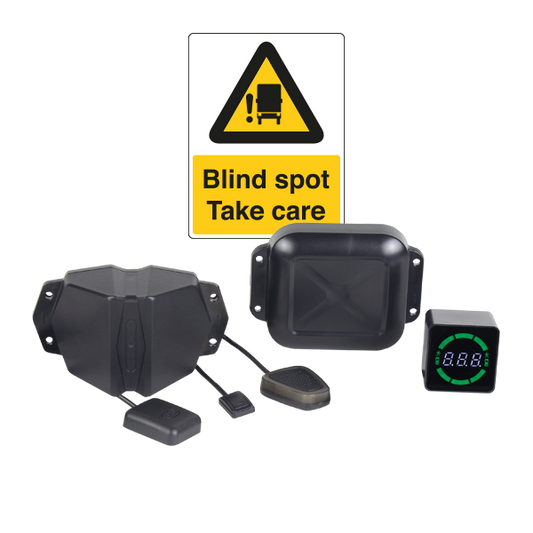
Blind spots remain one of the most stubborn safety risks for HGVs, especially in urban areas. Near-side blind spots are a particular concern in left-hand-drive road layouts, where pedestrians and cyclists may walk or filter close to the cab.
Modern systems use radar and cameras to monitor these zones and issue alerts when someone is present. For operators running into London, this technology also works with the Direct Vision Standard, keeping trucks compliant in the big city.
Lane keeping and positioning support
Lane departure warnings have been around for a while, but lane-keeping assistance is more sophisticated. These systems monitor lane position and, when necessary, provide gentle steering input to keep the vehicle centred.
While generally helpful on motorways, the systems can struggle on rural roads or on poorly marked carriageways, where the truck may offer warnings the driver knows are unnecessary. For this reason, drivers need time to get familiar with the system’s behaviour and limits.
360-degree hazard detection
One of the most noticeable upgrades in modern trucks is the use of multi-sensor “awareness” systems.
These combine camera feeds and radar data to create a wrap-around view of the vehicle, displayed on the in-cab screen. They are particularly useful in yards, depots, tight delivery points and city centres where hazards can appear from any direction.
Intelligent Speed Assistance (ISA) and traffic sign recognition
A number of additional features are becoming harder to ignore as safety expectations rise. Intelligent Speed Assistance (ISA) helps prevent accidental speeding by reading road signs and comparing them with GPS limits.
Traffic sign recognition assists in unfamiliar areas. Intersection collision warning is also gaining traction, particularly for fleets with frequent urban operations.

The table below outlines the key safety features, functions, and benefits of ADAS technology:
|
Feature |
What it does |
Advantages |
|
AEB |
Detects imminent collisions and applies emergency braking |
Prevents severe and low-speed crashes, reduces claims |
|
ACC |
Maintains distance to vehicle ahead |
Reduces fatigue, improves motorway safety |
|
Blind Spot Detection |
Monitors near-side and rear blind spots |
Protects pedestrians and cyclists |
|
Lane Keeping Assist |
Helps keep truck centred in lane |
Supports concentration on long motorway runs |
|
360° Awareness Systems |
Provides full vehicle-surround visibility |
Reduces yard collisions and manoeuvring incidents |
|
ISA & Sign Recognition |
Reads and enforces speed limits |
Helps avoid speeding incidents and penalties |
Additional safety technology
The landscape of truck operations in 2026 is shifting rapidly, driven not only by ADAS and connected fleet technology, but also by developments in automation, vehicle communication, and predictive systems.
Understanding these changes is essential for maintaining safety, efficiency, and competitiveness:
Advances in truck automation
Semi-autonomous features have moved beyond the concepts of science-fiction, into real-world application, particularly on long-haul motorway routes.
Functions such as lane centring, adaptive speed management, and platooning (where trucks follow a lead vehicle at close distance to save fuel and reduce driver workload) are now in limited deployment across certain UK corridors.
However, it’s important to be realistic. These systems are not designed to remove the driver. In fact, operators should treat automation as a support tool rather than a replacement.
Drivers must remain alert and able to take control at a moment’s notice. Understanding the boundaries of automation is a key part of safe operations.
V2X communication and intelligent route optimisation
One of the most transformative developments for fleet safety is vehicle-to-everything (V2X technology.
Vehicles can now communicate directly with other vehicles (V2V), roadside infrastructure (V2I), and wider traffic management systems. This allows for warnings about hazards such as sudden congestion or changes in traffic signals to reach drivers faster than traditional methods.
This hive mind approach allows trucks to proactively adjust speed in response to warnings, or reroute to avoid high-risk sections. Over time, fleets equipped with V2X-capable vehicles will likely see measurable reductions in collision rates, particularly for incidents caused by delayed hazard awareness.
Alongside communication systems, advanced route-planning tools now consider more than distance and delivery windows, analysing real-time traffic, weather forecasts, and historical road safety data to identify routes that minimise risk.
For example, a system may recommend a slightly longer motorway route that avoids accident hotspots during peak hours, or reroute around areas of high pedestrian activity in urban centres.
Predictive maintenance
Predictive maintenance has become a critical component of truck safety. Sensors within the truck are able to monitor brake performance, tyre wear, fluid levels, and engine components in real time. When the system detects a potential failure before it becomes critical, operators receive alerts, allowing maintenance to be scheduled proactively rather than reactively.
This reduces the risk of breakdowns on busy motorways, lowers unplanned downtime, and keeps fleets running efficiently. It also ensures that other systems, such as AEB and lane-keeping assist, remain fully operational—technology is only effective if it is correctly maintained.
Cybersecurity risks
However, as technology and automation continue to grow, so do the vulnerabilities they are exposed to.
A cyber breach not only exposes operational data, but can compromise vehicle safety. It is for this reason that truck operators must make certain that V2X systems, telematics, and on-board software are all regularly updated and protected against unauthorised access.
Understanding the UK regulatory landscape
Alongside technological advances, the UK regulatory landscape continues to evolve.
The Automated Vehicles Act 2024 sets the groundwork for how automated trucks are deployed on UK roads, assigning responsibilities and establishing standards to ensure safety keeps pace with innovation. Knowing what the law requires is as important as the technology itself.
The Statement of Safety Principles (SoSP)
At the heart of the act is the Statement of Safety Principles (SoSP), a framework that requires automated vehicles to achieve a safety standard equal to or better than that of careful and competent human drivers.
In practice, this means manufacturers and fleet operators need to demonstrate that their technology reliably mitigates risk, and does not introduce new hazards.
The implication here is clear. Even if a truck is equipped with the latest ADAS or semi-autonomous features, liability does not disappear. Proper deployment, driver training, and ongoing monitoring are all essential to meet legal obligations.
New liability framework
The act introduces two key legal roles that affect fleet management:
-
Authorised Self-Driving Entity (ASDE) - responsible for the behaviour of the vehicle when it is in self-driving mode. Operators need to ensure that vehicles sourced from these entities are compliant and that any issues are logged and reported promptly.
-
No User in Charge (NUIC) Operator - responsible for the non-driving aspects of fully autonomous vehicles, such as maintenance and roadworthiness. Fleets planning to adopt fully autonomous trucks will need clear operational procedures to meet NUIC responsibilities.
Understanding these roles helps to navigate liability, insurance, and operational planning as automation becomes more widespread.
Operators will need to maintain records demonstrating safe deployment, system performance, and driver oversight. Telematics and monitoring tools, when used correctly, can provide this evidence and support insurance claims if incidents occur.
Annual reports on vehicle performance must demonstrate that automated systems continue to meet the SoSP. This means that operators should implement routine checks, maintenance schedules, and performance audits for every automated or semi-automated vehicle in the fleet.
The regulatory landscape in 2026 is not designed to hinder operators, but to ensure that the integration of automated technologies enhances safety rather than shifting risk.
By understanding the SoSP, the ASDE and NUIC responsibilities, and post-deployment monitoring requirements, fleet managers can confidently implement advanced technologies while staying compliant and protecting both drivers and the public.
Frequently asked questions
What does ADAS stand for on a truck?
ADAS stands for Advanced Driver Assistance Systems: the combination of cameras, radar, ultrasonic sensors and processors that monitor a vehicle's surroundings and either warn the driver or intervene directly, through braking or steering input, to prevent a collision. It doesn't replace the driver. It's a support layer designed to catch what a human misses, particularly in poor visibility or heavy traffic.
Is ADAS mandatory on UK HGVs?
Not directly. The EU's General Safety Regulation (2019/2144) mandates blind spot and pedestrian/cyclist collision warning, intelligent speed assistance, driver drowsiness detection, event data recorders and, from 2026/2029, direct vision requirements for heavy vehicles, but the UK hasn't formally adopted it (Northern Ireland has, under the Windsor Framework). In practice, most new HGVs sold in Britain carry this technology anyway, since manufacturers build to EU specification rather than run a separate UK line.
How much can ADAS actually reduce crashes?
Research from Lero, the Science Foundation Ireland research centre at the University of Limerick, found that six ADAS features, adaptive cruise control, AEB, blind spot warning, electronic stability control, forward collision warning and lane departure warning, could cut UK road crashes by nearly 24% if fitted and used across the vehicle fleet. AEB alone was linked to a 28% reduction in intersection crashes and 27.7% in rear-end crashes. That study covered cars rather than HGVs specifically, but the same core systems are increasingly standard on new trucks too.
What's the difference between AEB and ACC?
AEB (Autonomous Emergency Braking) monitors the road ahead and applies full braking force if the driver doesn't react to a collision risk in time. ACC (Adaptive Cruise Control) is a comfort and concentration aid: it holds a set gap to the vehicle in front using radar, adjusting speed automatically in traffic. AEB is a last-resort safety system; ACC is there to reduce driver fatigue on long runs.
Who's liable if an automated truck is involved in a collision?
Under the Automated Vehicles Act 2024, liability depends on the vehicle's mode. When a vehicle is driving itself, the Authorised Self-Driving Entity, typically the manufacturer or software developer, carries responsibility for how it behaves on the road, not the driver. For fully autonomous vehicles with no user in charge, a licensed No User in Charge (NUIC) operator is responsible for maintenance, insurance and operational safety. Operating a NUIC vehicle without a licensed operator in place is an offence.
What safety standard must self-driving trucks meet under UK law?
The Automated Vehicles Act 2024 requires the Statement of Safety Principles to ensure that authorised automated vehicles achieve a level of safety equivalent to, or higher than, that of a careful and competent human driver, and that their deployment improves road safety in Great Britain overall. This is the legal benchmark manufacturers and operators have to demonstrate against, not a marketing claim.
Find truck safety parts at Truckstop Group
In 2026, safety technology is central to how trucks operate. However, technology alone is not enough. Success depends on disciplined implementation, consistent maintenance, and, above all, informed and engaged drivers.
Ultimately, the path to safer, smarter fleet operations lies in combining cutting-edge technology with practical, people-focused management. Those who do so will not only protect lives but also position their fleets for efficiency, resilience, and sustainable growth in the evolving transport landscape.
When you need to upgrade your fleet, Truckstop Group can support. We are national distributors for top brands including Bosch, Hella, Wabco, Yuasa, Durite and many others.
Shop truck and trailer parts today
Find more insights, news, and information in the truck industry at our Truckstop Group News Page.
A Deep Dive into Engine Oil Additives | Stay Compliant: Everything HGV Drivers Need to Know About the New Progressive Safe System (PSS) in 2024 | Wabco Modular ABS Sensors – Mix & Match For The Perfect Part
Sources:
Automated Vehicles Act 2024 | The UK's Automated Vehicles Act 2024 | Regulation (EU) 2019/2144 (General Safety Regulation) | New EU General Safety Regulation Published | Thatcham Research explains the new EU vehicle safety regulation | Safe Vehicles Save Lives | UK research finds use of 6 ADAS features would reduce crashes by nearly 24%