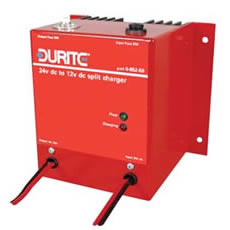
Split Charge Relays and Charge Splitter Devices
A split charge relay allows a vehicle's alternator to charge a secondary or auxiliary battery while protecting the main starter battery from being drained. This is a standard requirement on trucks with refrigerated bodies, tail lifts, living compartments or other high-drain accessories that need their own battery supply. Truckstop stocks split charge relays and voltage-sensing charge splitters for 12V and 24V commercial vehicle applications.
Split Charge Relay vs Voltage-Sensing Splitter
A basic split charge relay uses a signal from the ignition or a dedicated trigger wire to connect the batteries when the engine is running and isolate them when it stops. A voltage-sensing splitter monitors battery voltage directly and connects the batteries when charging voltage is detected, without needing a trigger wire. Voltage-sensing units are more flexible to install and work across a wider range of vehicle types and alternator configurations.
What is the purpose of a split charge relay in a truck?
A split charge relay ensures the vehicle alternator charges both the starter battery and any auxiliary batteries (refrigeration unit, tail lift, sleeping accommodation) while the engine runs, then isolates the batteries when the engine stops. This prevents the auxiliary load from draining the starter battery and leaving the driver unable to start the engine.
What current rating do I need for a split charge relay?
Select a relay rated for the maximum combined charging current from your alternator. Most truck alternators produce between 80A and 150A, so a relay rated for 140A continuous is suitable for most applications. For high-output alternator installations or where multiple auxiliary batteries are being charged simultaneously, contact the Truckstop trade team to confirm the correct specification.
Can a split charge relay be used to charge a trailer battery from the tractor unit?
Yes. Split charge relays are commonly used to charge trailer batteries from the tractor unit alternator via the trailer suzy connector. The relay is wired between the charging circuit and the trailer socket connection. This keeps the trailer battery topped up during transit, which is important for refrigerated trailers and trailers with brake or lighting systems that draw from an onboard battery.