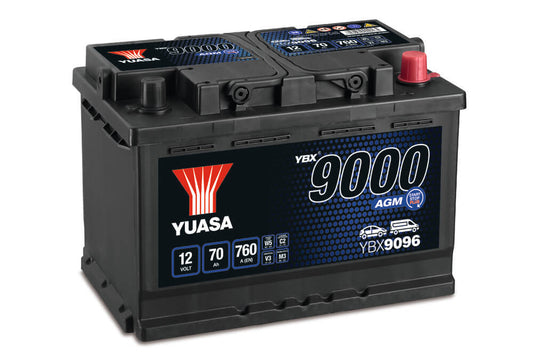

A flat battery is not an inconvenience for a commercial vehicle. Modern trucks and commercial vans are no longer simple starter‑motor machines. Telematics units transmit live tracking data 24/7. Refrigeration systems protect temperature‑sensitive loads. Sleeper cabs power lighting, heating, fridges, chargers and inverters long after the engine is switched off. Even when parked, parasitic drains from ECUs, security systems and monitoring equipment continue to draw current.
That shift in electrical demand has changed the rules. Two batteries that look identical can behave very differently under heavy cyclic loads, cold winter starts, or extended idle periods. Choosing purely on price or footprint often leads to premature failure and unnecessary downtime.
This guide breaks down what actually matters when buying a truck or commercial vehicle battery in the UK, so you can match specification to demand, not guesswork.
What does your vehicle need?
Most battery buying advice begins with brand comparisons or price brackets. That is the wrong starting point for commercial vehicles.
The first question is simple: what does your vehicle demand from the battery each day? Once you understand usage, the correct Ah, CCA and battery technology become obvious.
A long-haul HGV typically runs for hours at motorway speeds, giving the alternator time to fully recharge the batteries. Electrical load is steady and predictable.
An urban multi‑drop van is the opposite: dozens of start‑stop cycles, short journeys and limited recharge time. A diesel engine can draw 300–600 A on crank. Multiply that by 40–60 starts per day, and the battery lives in a constant state of stress.
Add auxiliary equipment, and demand rises sharply. Tail lifts can pull 150–200 A under load. Refrigeration units may draw 10–25 A continuously.
If these operate with the engine off, the battery acts as a deep‑cycle power source, something standard starter batteries are not designed for.
Sleeper cabs and parked fleet vehicles introduce further drain. Even small parasitic loads accumulate over days. Stop‑start vans increase cycle count dramatically and require EFB or AGM technology to cope.
The key point is that if you ignore usage, even a “correct” battery will fail early.
Before comparing battery prices, define your demand profile:
-
How many starts per day?
-
How many hours of engine-off electrical use?
-
Any high-draw auxiliary equipment?
-
Long-haul charging time or short urban cycles?
-
Extended idle periods?
Once those answers are clear, you can determine the required Ah rating, appropriate CCA margin, and whether standard flooded, EFB or AGM technology is the correct fit.
Understanding battery capacity (Ah)
Amp-hour (Ah) rating tells you how long a battery can supply current, not how powerful it is. Capacity must match your real electrical load profile, and that number changes with discharge rate, age and chemistry.
An amp-hour is a measure of charge. A 100 Ah battery can theoretically deliver 5 amps for 20 hours (its standard C20 rating) before reaching its cut-off voltage.
That rating is measured under controlled laboratory conditions at a steady discharge rate. Real-world performance varies.
Ah is about duration, not starting force (that’s CCA). Capacity determines how long your battery can support hotel loads, tail lifts, refrigeration systems or parasitic drain before voltage drops too low to crank.
Starter battery vs deep-cycle
Most commercial vehicle batteries are designed primarily for high current bursts (engine start), not repeated deep discharge. If you regularly draw large amounts of energy with the engine off, you are using the battery as a deep-cycle unit, whether it was designed for that or not.
Repeated deep discharge increases sulphation and plate wear, permanently reducing usable capacity over time. That’s why two identical 180 Ah batteries can behave very differently after a year in different duty cycles.
Matching Ah to Alternator Output
Capacity must be balanced with charging capability. Oversizing Ah without sufficient alternator output can leave the battery chronically undercharged, especially in short urban duty cycles. A larger battery takes longer to replenish. If recharge time is consistently insufficient, the battery remains in a partial state of charge, accelerating degradation.
Undersizing Ah increases depth of discharge during normal operation, which also shortens lifespan.
Over-specifying vs under-specifying
The goal is not the biggest battery that fits. It is the battery that covers your maximum expected discharge with a safe reserve margin.
-
Under-specify Ah: battery experiences deeper discharge, shorter life, and higher failure risk.
-
Over-specify Ah: higher cost, more weight, slower recharge, with no benefit if demand is modest.
Parallel battery systems in HGVs
Many HGVs use dual 12V batteries. In 24V systems wired in series, voltage increases, but Ah stays the same. In parallel systems, Ah increases while voltage remains 12V. Understanding this distinction is critical when calculating usable capacity.
Ah is about energy endurance. Size it for your real-world electrical demand, with recharge time and duty cycle in mind, not simply for what physically fits in the tray.

Understanding Cold Cranking Amps (CCA)
Cold Cranking Amps measure a battery’s ability to deliver high current at low temperature. If your CCA is too low, your diesel engine simply will not start, especially in winter.
CCA is defined by the SAE J537 standard as the number of amps a 12V battery can deliver for 30 seconds at -18°C while maintaining at least 7.2V (1.2V per cell).
This test reflects real-world cold-start stress. At low temperatures, electrochemical reaction rates slow and internal resistance rises, reducing available current. In simple terms: the colder it gets, the harder the battery has to work.
Why diesel engines need higher CCA
Diesel engines require more cranking current than petrol engines because:
-
They operate at higher compression ratios
-
Cold oil increases mechanical resistance
Starter torque is directly related to current draw. Heavy-duty diesel platforms, especially high-displacement HGV engines, require higher CCA ratings than passenger vehicles.
Even in the UK, winter temperatures regularly approach freezing. A battery that is marginal in summer can become unreliable in January. Cold conditions reduce effective cranking performance, which is why CCA should always include a safety margin.
When higher CCA makes sense
CCA is not capacity. It does not determine how long the battery will run auxiliary loads. A battery can have excellent CCA yet insufficient Ah for hotel loads or refrigeration systems.
Higher CCA is beneficial when:
-
Operating large diesel engines
-
Vehicles are parked outdoors overnight
-
Engines are ageing or high-mileage
-
Winter reliability is critical to operations
Typical CCA requirements by vehicle type
|
Vehicle type |
Typical engine type |
Approximate CCA range |
|
Small petrol car |
1.0–1.6L petrol |
300–500 CCA |
|
Medium diesel van |
2.0–2.5L diesel |
650–850 CCA |
|
Large diesel SUV |
3.0L diesel |
800–950 CCA |
|
HGV (single battery) |
Heavy-duty diesel |
900–1200 CCA |
|
HGV (dual battery 24V system) |
Heavy-duty diesel |
2 × 900–1200 CCA |
These ranges vary by manufacturer, but they illustrate the scale difference between petrol passenger vehicles and heavy commercial diesel platforms.
CCA is your cold-start safety margin. Size it for engine demand and winter exposure, but never treat it as a substitute for proper capacity planning.

Shop Car Batteries ➔
Selecting the correct battery technology
Battery technology determines how well your battery tolerates vibration, deep cycling, partial state-of-charge operation, and repeated high-current demand. In commercial vehicles, choosing the wrong chemistry shortens lifespan, even if Ah and CCA are technically correct.
Standard flooded lead-acid (FLA) batteries
Traditional flooded lead-acid batteries use liquid electrolyte and lead dioxide (PbO₂) positive plates with sponge lead negative plates.
During discharge, both plates convert to lead sulphate (PbSO₄), reversing during recharge, the fundamental reaction of lead-acid chemistry.
They are cost-effective and strong at engine starting. However, they are vulnerable to:
-
Repeated deep discharge
-
Sustained partial state-of-charge operation
-
Vibration in heavy-duty environments
Repeated partial charging promotes sulphation, the growth of stable lead sulphate crystals that reduce active material availability and increase internal resistance.
Best suited to: long-haul vehicles with consistent alternator recharge and minimal engine-off loads.
Enhanced flooded batteries (EFB)
Enhanced flooded batteries are an evolution of conventional flooded designs. They retain liquid electrolyte but incorporate:
-
Thicker plates
-
Polyester scrim or carbon additives to improve charge acceptance
-
Improved active material adhesion
EFBs are engineered to withstand higher cycle counts and partial state-of-charge operation typical in stop-start systems. Carbon additives in the negative plate improve dynamic charge acceptance and reduce sulphation under partial charging conditions.
Best suited to: stop-start vans and moderate auxiliary demand where cycling is frequent but not extreme.
Absorbent glass mat (AGM) batteries
AGM batteries suspend electrolyte in a fibreglass mat, reducing internal resistance and improving high-rate discharge capability. The key advantages of this design include:
-
Superior vibration resistance
-
Higher charge acceptance
-
Better deep-cycle tolerance
-
More stable performance under heavy load
Because the electrolyte is absorbed rather than free-flowing, AGM batteries are more resistant to stratification and spillage. Lower internal resistance also improves charge acceptance and high-rate discharge performance.
AGM batteries typically exhibit lower Peukert exponents and better high-rate efficiency than conventional flooded cells, meaning more usable capacity under load. Downgrading from AGM to flooded in a system designed for AGM typically reduces lifespan and can affect system performance.
Best suited to: sleeper cabs, refrigeration units, tail lifts, plant vehicles and high auxiliary demand platforms.
Technology comparison table
|
Feature |
Flooded Lead-Acid |
EFB |
AGM |
|
Electrolyte Type |
Liquid |
Liquid (enhanced plate design) |
Absorbed in glass mat |
|
Cycle Durability |
Low–Moderate |
Moderate–High |
High |
|
Partial State-of-Charge Tolerance |
Limited |
Improved |
Excellent |
|
Vibration Resistance |
Moderate |
Improved |
High |
|
Charge Acceptance |
Standard |
Improved |
High |
|
Typical Cost |
£ |
££ |
£££ |
|
Ideal Use Case |
Long-haul, low auxiliary demand |
Stop-start vans, moderate cycling |
Heavy auxiliary loads, sleeper cabs, refrigeration |
Chemistry must match duty cycle. If your vehicle behaves like a mobile power unit rather than a simple starter system, technology matters as much as capacity and CCA.

Shop Leisure Batteries ➔
Checking physical fit, terminal layout, and voltage
Electrical specs mean nothing if the battery does not physically fit, align correctly with the vehicle’s cable layout, or match the system voltage. A technically “perfect” Ah and CCA rating is useless if the battery cannot be installed safely and securely.
Case size and commercial fitment standards
Most UK trucks and vans use DIN/EN case sizes. That often means large-format batteries in the 110Ah–225Ah range mounted in side-lockers or chassis trays.
Before ordering, confirm:
-
Tray length, width and height
-
Hold-down type (bottom clamp vs top bracket)
-
Clearance in under-seat or side-mounted battery boxes
A battery that is even slightly undersized can move under braking or vibration. One that is too tall may foul covers or cab structures. In heavy vehicles, poor fit equals premature failure.
Never assume “close enough” is acceptable. Poor fit increases vibration stress and can shorten service life.
Terminal layout and heavy-gauge cabling
Truck batteries use thick, high-current cabling. These cables are not designed to stretch or twist to accommodate incorrect terminal orientation. You should check:
-
Positive terminal position (left/right layout)
-
Terminal type (standard post vs threaded stud)
-
Clearance to bodywork or battery lid
Incorrect layout can strain cables, increase resistance, or create installation safety risks. In 24V systems especially, accidental shorting during fitment can cause severe damage.
12V vs 24V truck systems
Most vans operate on 12V systems. Many heavy goods vehicles operate on 24V systems, achieved by connecting two 12V batteries in series.
In a series configuration:
-
Voltage adds (12V + 12V = 24V)
-
Capacity in Ah remains the same
In a parallel configuration (less common in trucks but used in some applications):
-
Voltage remains the same
-
Capacity in Ah increases
Incorrect voltage selection can damage starter motors, ECUs, alternators and onboard electronics immediately.
Never replace only one battery in a matched 24V series pair unless both are tested and confirmed healthy. Mismatched internal resistance between old and new batteries can cause uneven charging and premature failure.
Dual battery configurations
Many HGVs and high-demand vans use dual battery setups to increase cranking power or support auxiliary loads.
Common configurations include:
-
Two identical batteries wired in series for 24V
-
Two identical batteries wired in parallel for increased Ah capacity
-
Starter battery + auxiliary battery separated by a split-charge relay
When replacing batteries in dual systems, replace both at the same time where possible. You should also ensure identical specification (Ah, CCA, technology) and check equal cable length and condition.
Mixing AGM and flooded batteries within the same linked system is strongly discouraged due to different charging characteristics.
How to find the right battery for your vehicle
The fastest and safest way to choose the correct battery is to use the Truckstop Group Battery Finder which uses your vehicle registration number to identify:
-
Manufacturer-approved battery size and fitment
-
Correct voltage configuration (12V or 24V)
-
Minimum Ah and CCA requirements
-
Compatible battery technologies (Flooded, EFB, AGM)
Registration lookups reference DVLA vehicle data combined with manufacturer fitment specifications. Instead of manually interpreting technical tables, you receive a filtered list of compatible options in seconds.
Use the Truckstop Group Battery Finder today ➔
Frequently asked questions
How many Ah does a truck battery need?
Most heavy goods vehicles require between 110 Ah and 225 Ah per battery, depending on engine size, electrical demand and whether the system runs as 12 V or 24 V. The correct Ah rating is determined by total electrical load and expected engine-off usage, not just engine size.
The safest approach is to match or exceed the manufacturer’s recommended Ah rating within the correct physical size.
Is higher CCA better for diesel engines?
Higher CCA improves cold-start reliability in diesel engines, particularly in winter. Diesel engines operate at higher compression ratios than petrol engines, requiring greater starter torque and therefore higher current draw.
However, CCA measures short-duration high-current output, not overall energy capacity. Excessively prioritising CCA while ignoring Ah can result in a battery that starts strongly but struggles with auxiliary loads.
How long should an HGV battery last?
In commercial use, a quality battery typically lasts 3–5 years, depending on duty cycle, depth of discharge, vibration exposure and charging system health.
Frequent deep discharge, sustained partial state-of-charge operation, and high operating temperatures accelerate plate degradation and sulphation in lead-acid batteries.
AGM batteries may last longer than standard flooded units in high-cycling environments because they are engineered for improved cycle durability.
Can I replace a flooded battery with AGM?
In many cases, upgrading from flooded to AGM is beneficial, particularly if the vehicle experiences high auxiliary loads or deep cycling.
However, you should confirm the physical compatibility, charging system suitability and manufacturer recommendations first.
Why does my truck battery keep going flat overnight?
Common causes include:
-
High hotel loads (lighting, heaters, inverters)
-
Refrigeration systems operating engine-off
-
Parasitic drain from telematics or alarms
-
Age-related capacity loss
-
Alternator undercharging
Even small parasitic drains accumulate. A 0.05 A drain equals approximately 1.2 Ah per day. Over a month, that is 36 Ah which is enough to significantly reduce available starting power in a partially aged battery.
Battery testing should include both open-circuit voltage and charging system output verification.
What battery is best for tail lift trucks?
Tail lift trucks impose high intermittent current draw during operation. If lifts are frequently operated with the engine off, a higher Ah battery, or AGM technology, is typically preferable.
AGM batteries offer improved cycle durability and vibration resistance, making them suitable for vehicles with repeated auxiliary discharge. Where lift usage is heavy and sustained, consider systems designed for deeper cycling rather than standard starter-only batteries.
Find the right battery for your vehicle at Truckstop Group
Choosing the right truck battery is about matching specification to real-world demand. Capacity, CCA, and battery technology will help prevent failure risk, which in turn exposes your operation to unnecessary downtime.
At Truckstop Group, we stock a wide range of quality truck and leisure batteries to keep your vehicle on the road. If you’re unsure where to start, use the Truckstop Group Battery Finder to find the right model for your vehicle.
Shop Truck & Leisure Batteries today
Find more insights, news, and information in the truck industry at our Truckstop Group News Page.
Five HGV Parts You Need to Know About Before They Fail | The Future of the UK Truck Driver: 5 Big Shifts We Can See Today | UK Truck Safety Technology In 2026: What You Need To Know